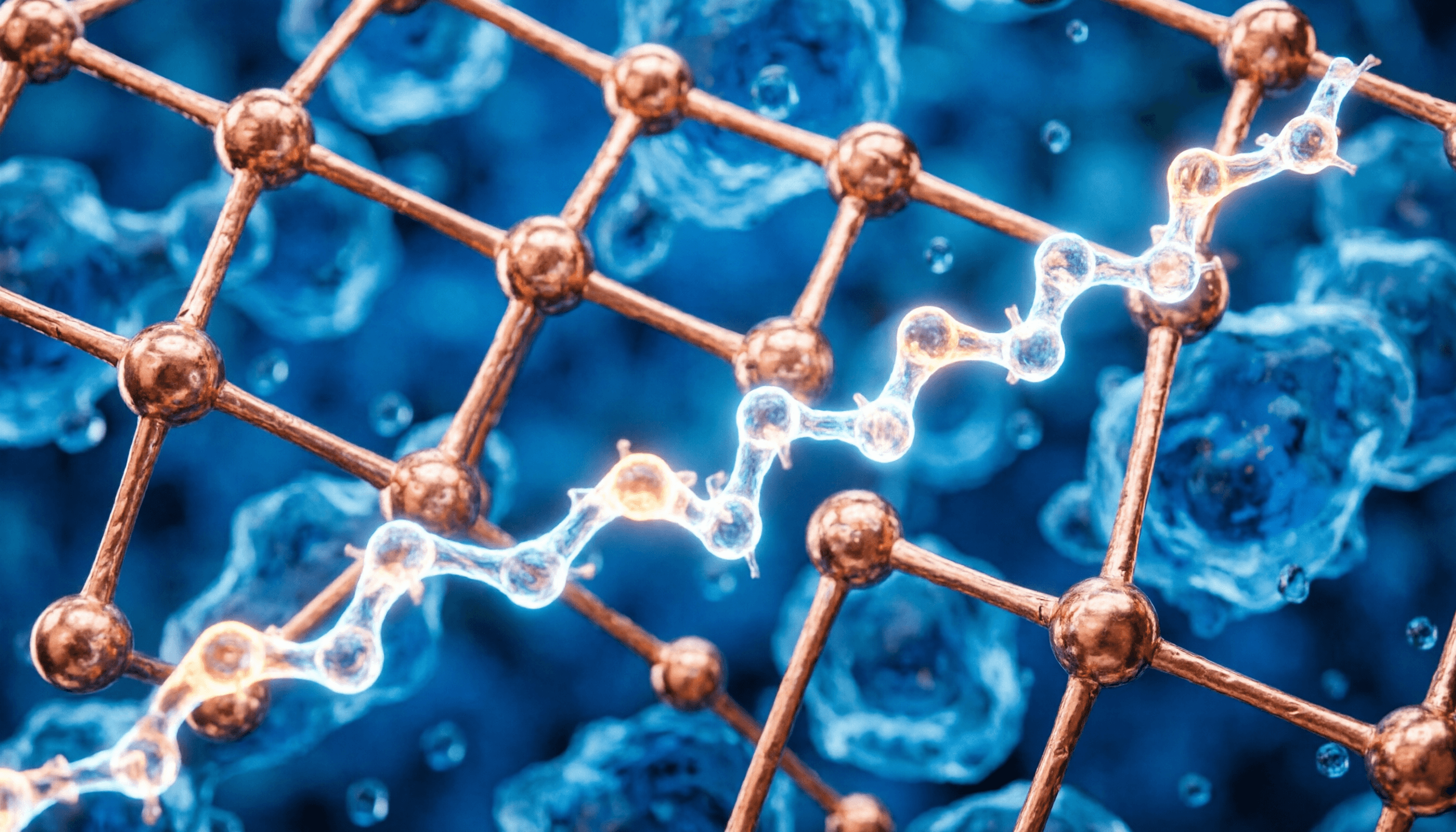
There is a quiet science happening every night while you sleep. Your body enters a state of active repair — rebuilding cellular structures, clearing oxidative debris, and laying down new connective tissue. For those who take recovery seriously, the question is not simply whether this process occurs, but how intelligently it can be supported. GHK-Cu 100mg sits at the heart of that conversation — a small but remarkably capable copper-bound tripeptide with decades of scientific attention behind it.
GHK-Cu, formally known as Glycyl-L-Histidyl-L-Lysine Copper, is not a synthetic invention. It occurs naturally in human plasma, saliva, and urine, and was first identified in 1973. What makes it compelling for modern research is the breadth of its biological activity: collagen and elastin synthesis, antioxidant defence, anti-inflammatory signalling, and gene-level regulation of tissue repair. As a research-grade peptide, it represents one of the most studied and structurally elegant molecules available today.
What GHK-Cu Actually Is — and Why the Copper Matters
At its core, GHK-Cu is a tripeptide — three amino acids (glycine, histidine, and lysine) chelated to a copper ion. That copper component is not incidental. Copper plays a critical role in enzymatic processes that govern collagen cross-linking, antioxidant enzyme activity, and tissue remodelling. The peptide acts as a biological carrier, delivering copper to the cellular environments where it is most needed.
This structure gives GHK-Cu a dual identity: it functions both as a signalling molecule and as a mineral delivery system. Research suggests it can modulate the expression of genes involved in tissue repair, immune response, and cellular regeneration — a scope of action that goes well beyond conventional skin-focused peptides. That is precisely what makes GHK-Cu 100mg a subject of ongoing interest in both cosmetic science and broader regenerative research.
The Regenerative Logic Behind GHK-Cu 100mg
The 100mg format of GHK-Cu offered by Olympus Meds is designed for research applications where consistent, measurable dosing matters. The peptide's studied mechanisms include stimulation of collagen and elastin synthesis — the structural proteins responsible for skin firmness, elasticity, and resilience. Over time, natural production of these proteins declines, which is why peptide-based research in this area has attracted sustained scientific interest.
Beyond structural proteins, GHK-Cu has demonstrated the ability to support tissue recovery after damage. This includes accelerating wound healing processes and reducing the inflammatory signals that can slow cellular repair. For researchers and advanced users building evening recovery protocols, these properties make it a logically central compound.
Key Studied Properties of GHK-Cu
- Collagen and elastin stimulation — supports the synthesis of structural proteins essential for skin integrity
- Antioxidant activity — helps protect cells from oxidative stress accumulated during the day
- Anti-inflammatory signalling — may reduce inflammatory markers that interfere with recovery
- Gene regulation — studied for its influence on genes related to tissue repair and immune function
- Skin density improvement — research suggests potential to improve skin thickness and reduce fine lines
- Hair follicle support — used in hair care research for its potential to stimulate follicle activity
- Wound healing acceleration — supports faster and higher-quality tissue closure after damage
GHK-Cu and the Evening Recovery Window
Sleep is the body's primary regenerative window. Growth hormone secretion peaks in the early hours of deep sleep, collagen synthesis accelerates, and inflammatory pathways quiet down. This is the biological context in which GHK-Cu becomes particularly relevant as a research compound — its mechanisms align directly with the cellular processes that dominate nighttime physiology.
The peptide's antioxidant properties are especially pertinent here. Daily life — exposure to UV light, environmental pollutants, physical stress — generates oxidative load that accumulates in skin and connective tissue. GHK-Cu's studied capacity to neutralise free radicals and reduce oxidative damage positions it as a compound that works with the body's nocturnal repair cycle rather than against it.
How GHK-Cu Fits into a Broader Recovery Protocol
No single peptide operates in isolation, and the most thoughtful recovery strategies recognise that different compounds address different layers of physiology. GHK-Cu's primary domain is skin and connective tissue regeneration — but researchers often examine it alongside compounds that support deeper cellular energy and systemic recovery.
One such compound worth noting is NAD+, a coenzyme central to mitochondrial energy production and DNA maintenance. While GHK-Cu works at the structural and extracellular matrix level, NAD+ operates within the cell's energy machinery. Together, they represent complementary layers of a recovery-focused research protocol — one addressing tissue architecture, the other supporting the cellular fuel systems that power repair. For those exploring systemic recovery alongside skin-focused regeneration, Ipamorelin is another compound that researchers have examined in this context, given its selective support for growth hormone release and its studied relationship with sleep quality and overnight recovery cycles.
These supporting mentions are provided for research context only. The central compound in any GHK-Cu protocol remains GHK-Cu 100mg itself, given its unique and well-documented mechanisms in tissue regeneration.
What Makes GHK-Cu Distinctive Among Regenerative Peptides
Many peptides in the regenerative category work through a single mechanism — stimulating one pathway, influencing one receptor type. GHK-Cu is unusual in the breadth of its studied activity. Its involvement in gene regulation sets it apart: research has identified its potential to upregulate genes associated with tissue repair and downregulate those linked to inflammation and cellular degradation.
This multi-layered action profile means that GHK-Cu is not simply a collagen booster in the conventional sense. It appears to interact with the body's own repair signalling systems in a more fundamental way — acting as a biological cue that prompts the cellular environment to shift toward regeneration. For a compound first identified over fifty years ago, the depth of ongoing scientific interest in GHK-Cu is itself a meaningful signal of its research value.
Sourcing GHK-Cu 100mg for Research
For researchers, formulators, and professionals working with peptide-based compounds, sourcing quality and consistency are non-negotiable. Olympus Meds provides GHK-Cu 100mg as a research-grade product, with the 100mg unit composition offering a practical quantity for structured investigation protocols.
It is also worth checking the current product availability and status page to confirm stock before planning a research cycle. For those working at scale or managing institutional research budgets, the bulk ordering page provides options designed for higher-volume procurement with the same quality standards.
Where to Access GHK-Cu 100mg from Olympus Meds
If GHK-Cu 100mg aligns with your research focus — whether in skin biology, tissue regeneration, antioxidant defence, or broader cellular recovery — Olympus Meds provides a straightforward path to procurement. The product page contains full compositional details and is the recommended starting point for any research planning.
Visit the GHK-Cu 100mg product page to review specifications and place your order. For larger research programmes or recurring supply needs, the Olympus Meds bulk page offers flexible options built for professional-scale use. Olympus Meds is committed to providing premium-grade research peptides with the transparency and consistency that serious scientific work demands.
Frequently Asked Questions
What is GHK-Cu and why is it relevant to recovery research?
GHK-Cu (Glycyl-L-Histidyl-L-Lysine Copper) is a naturally occurring tripeptide bound to a copper ion, first identified in 1973. It has been studied extensively for its role in stimulating collagen and elastin synthesis, reducing oxidative stress, modulating inflammatory pathways, and regulating genes involved in tissue repair. Its relevance to recovery research lies in the alignment of these mechanisms with the body's natural nighttime repair processes, making it a subject of significant interest for skin biology and connective tissue regeneration.
Is GHK-Cu 100mg suitable for professional or institutional research use?
Yes. The 100mg unit composition is designed to support structured research protocols requiring consistent, measurable quantities. Olympus Meds supplies GHK-Cu 100mg as a research-grade peptide. Professionals and institutions requiring larger volumes are encouraged to explore the bulk ordering options available on the Olympus Meds platform.
Can GHK-Cu be researched alongside other peptides?
Many researchers examine GHK-Cu within broader multi-compound protocols, as its mechanisms — focused on extracellular matrix regeneration and antioxidant defence — complement rather than overlap with peptides that target cellular energy, systemic recovery, or hormonal signalling. Any multi-peptide research design should be developed with appropriate scientific oversight and a clear understanding of each compound's individual profile. Always review the product status page to confirm availability before planning your protocol.